
FreD Info




Why should you offer FreD?
Is FreD even an option for our facilities?
Who is the target group for FreD courses?
Who are the regional cooperation partners for this program?
How does a FreD course actually work?
FreD is aimed at adolescents and young adults. It is also aimed at the relevant institutional actors in the field.
FreD is a short-term, early intervention approach. It is designed for young people who may be at the beginning of a manifest addiction problem. FreD offers an opportunity for reflection at the moment when they first come to attention because of their substance use.
The FreD course is not intended as a punishment, regardless of the setting in which it is delivered. Rather, it is an offer of help for self-help for young people who engage in risky consumption. FreD enables educational intervention through the support system.
Even if the course is linked to a condition, the aim of FreD is not to punish drug or alcohol consumption, but to motivate young people to change their consumption behavior. This may be the case, for example, if young people who consume risky illegal substances are required by the public prosecutor's office to attend a FreD course. However, this may also be the case if young people are caught with cannabis at school and are required by the school to participate in FreD.
Participating young people enjoy two advantages through FreD:
Local institutions intervene when it makes sense
Local addiction experts are concerned that some young people are using intoxicants excessively. Mixed consumption in particular is becoming more and more of a problem. This situation has a massive impact on society as a whole – and, of course, on the young people themselves.
The FreD program has developed tools to gain early access to young people and young adults with problematic consumption habits through schools, regulatory authorities, youth welfare services, the police, the justice system, the workplace, families, etc.
This is where FreD's advantage lies: initial interventions are implemented when it makes sense to do so. Young people are reached before “the damage is done.”
Another opportunity for FreD, especially for municipalities:
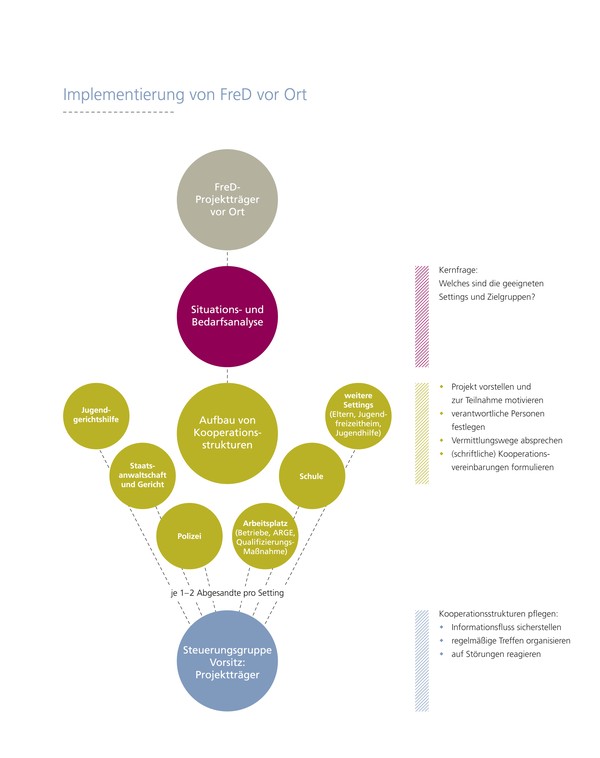
New and effective cooperation structures are being established locally between the various relevant stakeholders. This is linked to a sustainable improvement in the quality of addiction support and prevention. FreD enables particularly vulnerable groups to be reached and identified. The FreD contact facilitates referral and support in further (addiction) support services (internal and external).
Successful cooperation structures are a prerequisite for the long-term success of the FreD program on the ground.
Consumers of illegal or legal drugs who have not yet developed a manifest addiction. FreD is not suitable for heroin users or young people with no experience of drug use.
FreD is the right measure for
The “others” can be
The purpose of all FreD measures: Young people should attend the FreD course and reflect on their intoxicant consumption.
FreD is implemented in a town or region by a prevention center, (youth) addiction counseling center, or similar institution. This center definitely needs cooperation partners. Only then can the intervention be successful.
Institutions that notice young people due to their alcohol or drug consumption are ideal cooperation partners.
These could be, for example:
The FreD provider relies on its cooperation partners to convince young people of the benefits of FreD and then refer them to the courses. Reducing skepticism and building trust in the FreD intervention is therefore one of the most urgent tasks.
FreD intervention measures follow a specific sequence:
A young person has been noticed consuming psychoactive substances (cannabis, alcohol, ATS, etc.) in an inappropriate manner. The institution where the young person was noticed establishes contact with the local FreD provider (FreD location).
The young person contacts the FreD course leader on their own initiative or on instruction.
An individual interview between the course instructor and the young person is used to assess their situation, overcome any inhibitions, and build trust in the program.
Together with five to ten other young people who have come to the attention of the authorities, the young person then takes part in a course designed to encourage them to reflect on their drug use. The course lasts eight hours and is spread over two to four evenings. Up to two course leaders supervise the course.
After completing the course, the young person receives a certificate of participation. Whether this is forwarded to the institution that established contact with FreD is decided on a case-by-case basis.
Of course, participation in the FreD course is always possible.
The young person contacts the FreD location themselves and independently to arrange an appointment. Together with the FreD trainer, they will determine whether participation in the FreD course is the right option.
Since its inception in 2000, FreD has been a selective prevention program specifically tailored to alcohol and substance abuse among young people.
More and more young people were using illegal drugs, especially cannabis, it was found at the time. Worse still, young people lacked awareness of the problem. There were no evaluated prevention concepts for this group.
The aim of the federal model project FreD was therefore to develop a short, early intervention, health-conscious program for young people who had come to the attention of the police and the courts for the first time because of their use of illegal drugs. In particular, the aim was to reach the group of young people and adolescents whose proceedings for violations under Section 31a) of the Narcotics Act were (expected to be) discontinued. After an “intake interview,” an eight-hour group course was and is offered to reflect on one's own substance use. FreD was funded by the then Federal Ministry of Health and Social Security (BMGS).
More relevant than ever after 20 years
Twenty years after its inception, FreD is more relevant than ever. Behavioral and environmental prevention measures have been successful, as the number of young people who use intoxicants has declined over this period. However, the number of those who smoke cannabis or drink alcohol heavily is clearly not decreasing.
Combined consumption in particular is on the rise. Researchers in the 2010 HBSC study found that 47% of young people who regularly smoke cannabis also regularly consume alcohol. Overall, only 19.9% of young people in this age group regularly drink wine, beer, or spirits.
Figures from the German Employees' Health Insurance Fund (DAK) from 2008 show that 28.3% of 12- to 25-year-olds have smoked cannabis at least once in their lives. That is less than four years ago. However, for 3.7% of this group, their last consumption was no more than a month ago.
The situation is even more critical when it comes to alcohol. When the DAK finds that 43% of 10- to 18-year-olds drink five or more glasses of alcohol in a row at least once a month, this also means that every second 15-year-old is already an experienced binge drinker.
The Federal Center for Health Education (BZgA, 2011) also found that the 12- to 15-year-old age group in particular is bucking the downward trend in alcohol consumption.
For this reason, the European project FreD goes net has expanded the target group for short intervention courses to include young people with problematic alcohol consumption. In addition to the police and the judiciary, schools, workplaces, and youth welfare services have also been added as further settings.
Update your browser to view this website correctly.